By Mushtaq Ul Haq Ahmad Sikander, New Age Islam
13 October 2026
Intellectual Renewal, Peace and Political Realism
Maulana Wahiduddin Khan’s Issues of Ijtihad presents ijtihad as a living method of reasoned engagement with modern challenges, while advocating peaceful communication, moral reform and realistic political action.
Main Points
- Khan contrasts the closed, imitative (taqlidi) mind with the open, reflective (ijtihadi) mind, urging Muslims to respect earlier scholars without treating their conclusions as permanently binding.
- The book foregrounds dawah—peaceful invitation, dialogue and moral persuasion—over confrontation, armed struggle and the pursuit of state power.
- Khan replaces the classical division of Darul Islam and Darul Harb with Darul Dawah, encouraging Muslims in plural societies to act as responsible citizens and ethical communicators.
- The book is valued for challenging intellectual stagnation, blind imitation and extremist violence, though its peace framework needs a fuller account of justice, rights and resistance to structural injustice.
A review of Maulana Wahiduddin Khan’s call for intellectual renewal, peace and realistic engagement
Author: Maulana Wahiduddin Khan
Translated and edited by: Prof. Farida Khanam, Dr. Rajat Malhotra and Maulana Farhad Ahmad
Publisher: Goodword Books, New Delhi NCR, India
Year of publication: 2026
Pages: 306
ISBN: 9788169327022
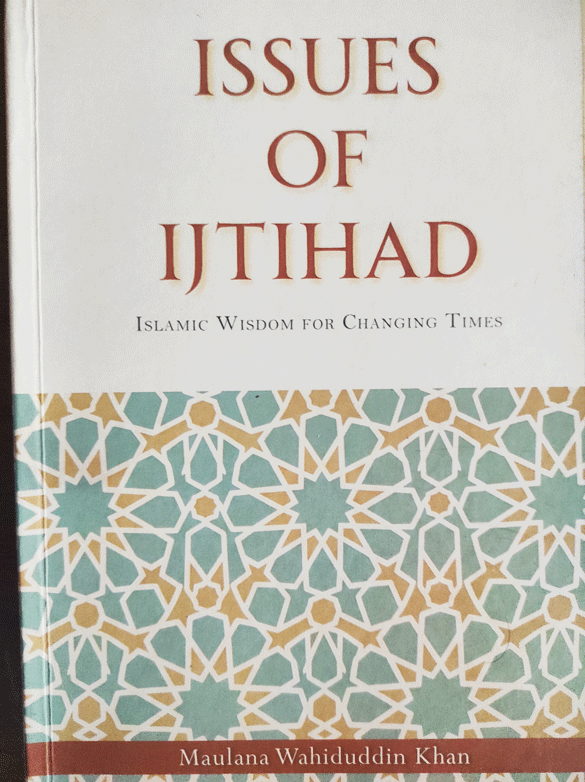
Maulana Wahiduddin Khan’s Issues of Ijtihad: Islamic Wisdom for Changing Times is not merely a book about a technical juristic concept. It is a passionate, sometimes provocative, argument that the Muslim world’s deepest crisis is intellectual: the abandonment of independent reasoning, the cult of blind imitation, and the substitution of confrontation for the Quranic mission of peaceful communication. The English text, translated from Khan’s Urdu work Masail-e-Ijtihad, presents ijtihad as “the effort to discover the guidance of Islam for new situations with wisdom, realism, and a peaceful approach.”
The book’s central claim is bold: Muslims have not merely lagged behind in science, technology or political power, they have allowed the mind itself to become captive. Khan contrasts the taqlidi mind, an imitative, closed mind with the ijtihadi mind, which remains open, reflective and capable of reassessing changing circumstances. His recurring image is striking: later generations should not lie at the feet of their predecessors; they should stand upon their shoulders.
This book is a serious work of Islamic reformist thought. It is valuable because it restores ijtihad to its proper place as a living intellectual method rather than an antiquarian slogan. Yet it is also a book that demands critical reading. Khan’s peace-centred reading of Islam is morally compelling, but some of his political judgments, especially on Kashmir, Pakistan, democracy and authoritarian rule, are likely to generate disagreement. The book is strongest when it calls Muslims to intellectual courage, dialogue and non-violence, it is most contested when it turns these principles into a particular political prescription.
The crisis of imitation
Khan begins with a diagnosis that will resonate with anyone concerned about the intellectual stagnation of Muslim societies. He argues that the process of intellectual evolution among Muslims has “almost come to a standstill” because imitative thinking dominates and independent reasoning has been abandoned, even treated as a vice. His distinction is simple but powerful. The imitative person believes that everything worth discovering has already been discovered by earlier scholars. The independent thinker honours the past but recognises that new times generate new questions. Khan writes that a living community cannot remain confined to approaches shaped by earlier circumstances, it must have the courage to think anew in the light of the Quran and Sunnah.
The author’s use of George Bernard Shaw’s remark about Shakespeare illustrates his point. Shaw acknowledged Shakespeare’s greatness but said that he stood upon his shoulders. Khan asks Muslims to adopt the same attitude toward the early jurists, hadith scholars and theologians: respect them, learn from them, but do not make their historical conclusions permanently binding on every later age.
This is not a call for disrespect toward the Islamic intellectual tradition. Khan repeatedly emphasises that ijtihad does not mean arbitrary opinion-making. It involves reflection on the Quran and Sunnah and the derivation of guidance through analogy and inference where clear texts or consensus are absent. The problem, in his view, began when later Muslims came to believe that the early jurists had completed all necessary ijtihad and that subsequent generations should only interpret and apply earlier juristic works.
Khan’s language can be severe. He compares a community that suspends ijtihad to a river whose flow has been obstructed, it ceases to be a living river and becomes a stagnant pond. The metaphor captures the urgency of his argument. For him, intellectual stagnation is not a private failure of scholars; it is a collective disaster that affects religion, education, politics, ethics and the Muslim community’s ability to engage with modernity.
Rereading hadith and fiqh
One of the most interesting sections of the book concerns the study of hadith. Khan does not question the authority of hadith; rather, he argues that Muslims must move beyond merely memorising texts or accepting the chapter titles under which earlier compilers placed them. He proposes a multi-stage approach to hadith study: collection, indexing, interpretation, contextual analysis, and eventually a comprehensive encyclopaedia of authentic hadith that would enable modern readers to engage with the material in contemporary scholarly ways.
His examples are instructive. The Prophet’s standing in respect for a Jewish funeral, with the words, “Was he not a human being?”, is traditionally placed in the chapter on funerals. Khan argues that restricting the hadith to funeral law obscures its larger ethical message, Islam demands respect for every human being, irrespective of religion, nationality or political affiliation.
Similarly, he reads the Prophet’s decision not to rebuild the Kaaba on Abraham’s original foundation as a lesson in practical wisdom. Rebuilding it might have been religiously preferable, but the Prophet refrained because the social circumstances made such an act potentially disruptive. From this, Khan derives a principle that becomes central to the entire book: in life, the question is not always what is abstractly right or wrong, but what is possible and impossible under given conditions.
This pragmatic hermeneutic has great force. It challenges a certain kind of religious maximalism that insists on enforcing ideals without assessing consequences, capacities or social readiness. Khan applies it to contemporary calls for the immediate enforcement of Shariah. He argues that early Islamic legislation unfolded gradually, after hearts had become receptive to faith, therefore, attempts to impose Shariah through state power without moral and intellectual preparation are doomed to fail.
Here Khan’s argument is persuasive, though it requires nuance. The gradualism of early revelation cannot be mechanically transferred to every modern legal or political question. Yet his broader warning remains important: law without inner transformation, education and social consent can become coercive symbolism rather than lived religion.
Fiqh of power, fiqh of modesty
Perhaps the book’s most original contribution is its critique of classical fiqh as a jurisprudence largely formed during eras of Muslim political dominance. Khan argues that the foundational corpus of Islamic jurisprudence was compiled during the Abbasid period, when Muslims were a major global power. Consequently, that fiqh naturally reflected the assumptions, priorities and possibilities of a ruling civilisation.
This does not mean that classical jurists were insincere or that their work lacks religious value. Khan’s point is historical and methodological, a legal tradition shaped in conditions of power may not adequately guide Muslims living as minorities, politically weak communities, or citizens of plural modern states. He notes that traditional jurisprudence developed models for a position of strength but offers little guidance for a “position of modesty.”
This observation has profound implications. Much contemporary Muslim political thought begins from the assumption that Muslims must recover power, establish an Islamic state, or confront the existing order. Khan reverses the question, how should Muslims live, communicate their faith and contribute to society when they do not possess political power?
His answer is dawah, peaceful invitation, explanation and communication of Islam. He argues that the Quran’s primary call is dawah, whereas large sections of Muslim political practice have become preoccupied with qital, fighting or armed struggle. This is perhaps the book’s sharpest contrast: a religion centred on persuasion has too often been interpreted as a religion centred on power.
Khan’s critique of traditional fiqh is supported by the observation that classical jurisprudential works contain extensive discussions of jihad and war but no comparable chapter on dawah. Whether or not one accepts this as a complete description of the fiqh tradition, it highlights a real imbalance in contemporary Muslim consciousness. The vocabulary of war, fronts, enemies, conquest and retaliation has become more emotionally available to many Muslims than the vocabulary of dialogue, persuasion, patience and moral example.
From Darul Harb to Darul Dawah
Khan’s replacement of the classical dichotomy of Darul Islam and Darul Harb with Darul Dawah or Darul Insan is one of his best-known interventions. In this book, the idea receives a forceful restatement. For him, the modern world is not a “land of war” simply because Muslims do not control its political institutions. It is a field of communication, coexistence and peaceful invitation.
This reconceptualization changes the entire orientation of Muslim engagement with non-Muslim societies. If the world is Darul Harb, the Muslim is encouraged to think in terms of confrontation, loyalty to a distant ideal state, and eventual triumph through struggle. If it is Darul Dawah, the Muslim is called to become a responsible citizen, a moral witness and a communicator of faith.
The idea is especially relevant in plural societies such as India, where Muslims live as a significant minority. Khan’s argument suggests that Muslim energies should be directed toward education, intellectual confidence, ethical conduct, interfaith understanding and peaceful social participation rather than toward fantasies of political revenge or separatism.
At the same time, the concept should not be romanticised. Calling the world Darul Dawah does not erase injustice, discrimination, occupation or communal violence. Muslims may still need legal protection, political representation and resistance to oppression. But Khan’s contribution lies in insisting that even resistance must be morally intelligible, practically effective and consistent with Islamic ethics.
The Prophet’s method of consultation
Khan repeatedly turns to the life of Prophet Muhammad to support his argument that Islam values consultation, flexibility and realistic judgment. His discussion of the Battle of Badr emphasises that the Prophet listened to the opinions of his Companions before choosing the battlefield. The episode becomes, in Khan’s hands, an example of leadership through consultation rather than authoritarian command.
This is an important corrective to political cultures in which religious authority is treated as incompatible with debate. Khan suggests that the Prophet’s greatness lay not only in receiving revelation but also in creating a community capable of deliberation. He listened, weighed advice, and adapted strategy according to circumstances.
The Treaty of Hudaibiyyah is similarly presented as an act of ijtihad. Khan sees it not as weakness or compromise of principle, but as a strategic peace agreement that opened space for the peaceful expansion of Islam. The treaty initially appeared humiliating to some Companions, yet Khan reads it as proof that peace can be more productive than confrontation.
This reading has obvious contemporary relevance. In conflicts ranging from communal disputes to international wars, leaders often mistake rigidity for courage. Khan’s account of Hudaibiyyah argues that accepting an imperfect peace may sometimes protect the larger mission better than pursuing a symbolic victory through violence.
Yusuf, power-sharing and political realism
The book also invokes Prophet Yusuf’s participation in the Egyptian administration as an example of realistic engagement with power. Khan’s point is that religious commitment does not necessarily require withdrawal from public institutions. A believer may work within existing structures if such participation enables constructive service and does not compromise fundamental ethical commitments.
This argument challenges revolutionary interpretations of Islam that treat every existing political order as illegitimate until it is replaced by an Islamic state. Khan’s reading of Yusuf suggests a more patient approach: reform may occur through participation, expertise, moral integrity and gradual influence. However, this example also raises questions. Yusuf’s case involved a prophet with exceptional moral authority operating in a particular historical context. It cannot automatically justify uncritical collaboration with unjust regimes. Still, Khan’s broader principle, that Muslims should not equate faith with permanent opposition to every government remains significant.
Against political Islam
A recurring theme in the book is Khan’s opposition to the political interpretation of Islam. He argues that Islam has been wrongly reduced to a project of establishing political rule, capturing state power and implementing a legal system from above. In his view, this interpretation distorts the Quranic message and turns teachings meant for self-reform into instruments for controlling others.
Khan’s objection is not that Muslims should be politically indifferent. Rather, he insists that Islam’s primary field of action is the individual conscience, moral character and peaceful communication. He argues that there is no Quranic directive commanding Muslims to establish Islamic rule; teachings about justice, when misread, have been turned into a mandate to impose justice on the world by force.
This critique places him in tension with Islamist movements, including those influenced by Maulana Abul Ala Maududi. Khan explicitly regards the political interpretation associated with Maududi as problematic and as a source of strife. His alternative is not secularism in the conventional sense, but a spiritualised and ethical understanding of religion. The strength of this position is its refusal to make Islam hostage to failed political projects. The weakness is that it can sometimes understate the legitimate political aspirations of Muslims living under occupation, authoritarianism or institutional discrimination. A complete Islamic response must hold together spiritual reform, peaceful civic engagement and resistance to injustice without allowing any of these to collapse into violence.
Wahdatul Wujud and theological boundaries
Khan’s opposition to Wahdatul Wujud, the doctrine often associated with certain Sufi metaphysical traditions, adds a theological dimension to the book. He rejects interpretations that blur the distinction between the Creator and creation. For him, such ideas can undermine the clear Quranic affirmation of God’s transcendence and the creaturely status of human beings.
This position will be contested by readers influenced by Ibn Arabi and other Sufi thinkers. Yet Khan’s concern is understandable, he fears that mystical language, when detached from disciplined theology, may encourage passivity, fatalism or a diluted sense of moral responsibility. His critique also reflects his broader intellectual temperament. Khan wants Islam to be clear, rational, action-oriented and morally responsible. He is suspicious of ideas that appear profound but, in his judgment, weaken the believer’s capacity for realistic action.
Kashmir, Pakistan and the price of confrontation
The book’s discussion of Kashmir and Pakistan is likely to be its most controversial section. Khan argues that Kashmir has become a “trapdoor” for Pakistan, drawing it into a prolonged confrontation that has weakened the country rather than strengthened it. He urges Pakistan to accept the political status quo and pursue compromise over Kashmir.
This is a difficult argument, particularly for readers in Kashmir who have experienced conflict, loss and political uncertainty. Khan’s position should not be read as indifference to Kashmiri suffering. Rather, it reflects his consistent belief that armed struggle produces more destruction than constructive results and that political realism may sometimes demand accepting a situation one does not like in order to preserve life and create space for future change.
Still, the prescription is open to serious criticism. A status quo is not morally neutral when it is sustained by coercion, demographic anxiety or denial of political agency. Peace cannot mean asking the weaker party alone to surrender its claims while structural injustice remains untouched. Khan’s peace ethics is most convincing when it calls all parties to non-violence and dialogue; it becomes less convincing when it appears to place the burden of adjustment disproportionately on one side.
His argument also reflects a wider limitation in his political thought, a tendency to treat peace as an almost self-evident good, without always specifying the institutional conditions under which peace can be just. True peace requires more than the absence of gunfire. It requires dignity, accountability, rights and a credible political process.
Democracy, colonialism and authoritarian temptation
Khan’s comments on democracy and authoritarian rule are equally provocative. He suggests that Shah Waliullah was not aware of democracy because the political reality entering the subcontinent was colonialism and imperialism, not democratic self-rule. This historical observation has merit: democracy in South Asia emerged under deeply unequal colonial conditions and was shaped by imperial interests. More controversially, the book contains passages that appear to praise dictators for their capacity to do what elected leaders cannot. This is a dangerous proposition. Authoritarian leaders may act quickly, but speed is not wisdom, and decisiveness is not legitimacy. Dictatorships often suppress dissent, weaken institutions, foster corruption and leave societies politically immature.
Khan’s apparent admiration for authoritarian efficiency sits uneasily beside his deeper message of consultation, criticism and intellectual freedom. If ijtihad requires open minds, debate and the ability to reassess, then political systems that silence criticism are structurally hostile to ijtihad. A reader may therefore regard this element of the book as an inconsistency rather than a coherent political theory.
Media, othering and the obstacles to dawah
Khan is alert to the role of modern media in shaping conflict. He argues that media culture often demonises the “other,” turning complex human beings into stereotypes and making dialogue more difficult. This observation is highly relevant in an age of television debates, social-media outrage and algorithmic polarisation. When communities are represented only through the actions of extremists, criminals or political adversaries, the possibility of empathy disappears. Muslims may be portrayed as inherently violent; non-Muslims may be portrayed as enemies of Islam. In both cases, media reduces human beings to symbols and makes dawah, coexistence and mutual understanding harder.
Khan’s response is not censorship but intellectual discipline. Muslims must learn to distinguish between individuals, ideologies, states and communities. They must resist reactive thinking and cultivate a reflective response. The book’s section on “Reactive versus Reflective Response” captures this ethical demand. This is one of the book’s most constructive contributions. It reminds readers that peace is not merely a policy issue, it is also a habit of perception. A community that constantly sees enemies will produce enemies. A community capable of seeing human beings beyond labels may discover partners for dialogue.
Palestine, violence and the limits of armed struggle
Khan’s reflections on Palestine follow the same logic as his views on Kashmir. He argues that peace, rather than violence, offers the only realistic path toward meaningful results. For him, armed struggle deepens suffering, invites retaliation and diverts energy from education, institution-building and moral persuasion. This position will be emotionally difficult for many readers, especially in the context of Palestinian dispossession and violence. It is important to distinguish between condemning violence and denying injustice. Khan’s argument does not require Palestinians to accept oppression as normal, rather, it insists that the method of response must be morally and practically effective.
Yet the argument again needs qualification. Non-violence is not merely waiting; it requires organisation, solidarity, legal advocacy, international pressure and a credible political process. If peace is presented as passive endurance, it can become a counsel of despair. Khan’s best insight is that violence cannot build a just future, his unfinished task is to show how peaceful resistance can become powerful enough to challenge entrenched power.
Terrorism, condemnation and moral consistency
Khan’s treatment of terrorism is direct. He argues that terrorism cannot be condemned merely by calling it “un-Islamic” while those who continue violence in the name of jihad escape serious moral criticism. He calls for open condemnation of terrorism and insists that Muslims must confront the misuse of religious language by violent actors. His sarcastic description of terrorism as “armed struggle by NGOs” highlights his view that non-state armed groups lack the legitimacy, accountability and responsibility associated with established political authority. This position is consistent with his broader argument that only an established government may declare war, while guerrilla and proxy wars fall outside legitimate Islamic frameworks.
Khan’s demand for moral consistency is important. It is insufficient for Muslim leaders to condemn terrorism in abstract terms while allowing extremist rhetoric, sectarian hatred or calls for violence to flourish within their own communities. Condemnation must be public, unambiguous and directed at those who spread “corruption in the land.” At the same time, the term terrorism must not become a blanket label for every act of resistance. A serious ethical framework must distinguish between civilians, combatants, state violence, occupation and self-defence. Khan’s moral clarity is valuable, but it must be joined to legal and political precision.
Religion, science and the complete ideology
The book also contains discussions of belief in God, science, contentment and clear thinking. Khan presents religion as a complete ideology capable of addressing both external and internal questions of human life. He sees faith not as a retreat from reason but as a framework that gives meaning to human existence, guides moral action and provides spiritual equilibrium. His engagement with science is largely apologetic, he seeks to show that modern scientific discoveries can strengthen belief in divine wisdom rather than undermine it. This approach may appeal to readers seeking reconciliation between faith and modern knowledge, though professional philosophers of science may find some of his arguments simplified.
More compelling is his discussion of contentment. Khan treats contentment not as complacency but as inner stability that enables purposeful action. A person consumed by envy, resentment or frustration becomes reactive. A person with inner peace can think clearly and pursue long-term goals. This connects the book’s spiritual and political arguments. Khan believes that violence often arises from frustration, while patience creates the psychological space necessary for wise action. His message is that Muslims must cultivate not only institutions and strategies but also habits of mind capable of sustaining peace.
Power belongs to God
A theological principle underlies Khan’s entire political vision: power is given by Allah and is not to be fought for as an end in itself. This idea challenges the modern political obsession with state capture, electoral victory and ideological dominance.
For Khan, the believer’s task is not to seize power but to remain faithful to ethical principles, communicate truth peacefully and trust that outcomes rest with God. This does not mean fatalism. It means that political action must be freed from the ego’s hunger for domination. The idea has deep Quranic resonance. It reminds Muslims that authority is a trust, not a trophy. Leaders who treat power as personal property betray the ethical meaning of governance. Citizens who treat political power as the sole measure of religious success reduce Islam to a worldly ideology.
Khan’s insight is especially relevant in an age when religious identity is frequently mobilised for electoral gain, nationalist projects and armed conflict. His alternative is demanding: believers must resist the temptation to make power the centre of faith.
War in the age of MAD
Khan’s final argument is historical and existential. War is outdated in the age of mutually assured destruction. In a world of nuclear weapons, mass destruction and interconnected economies, war no longer produces clear victories, it threatens catastrophe for all parties. This is perhaps the book’s most urgent contemporary message. The logic of MAD does not apply only to nuclear powers. Regional conflicts, proxy wars, terrorism and communal violence can all trigger escalations whose consequences exceed the intentions of those who begin them.
Khan therefore calls for a culture of peace rather than a culture of the gun. He argues that peaceful means are not weak, they are often more powerful because they preserve human life, protect moral purpose and create possibilities for reconciliation. This argument deserves wide circulation. It challenges both state militarism and non-state extremism. It insists that the real test of strength is not the capacity to destroy but the capacity to protect life, sustain justice and build institutions capable of resolving conflict without bloodshed.
A necessary but contested book
Issues of Ijtihad is a necessary book because it challenges Muslims to recover intellectual confidence. It rejects the idea that faith requires submission to inherited conclusions. It insists that the Quran and Sunnah remain living sources of guidance, capable of illuminating new circumstances. It calls for criticism, dialogue, consultation and peaceful action. The book is also valuable because it refuses to romanticise violence. Khan’s insistence that dawah, not qital, is the Quranic mission is a powerful corrective to extremist interpretations of Islam. His reconceptualization of the world as Darul Dawah offers Muslims a constructive way to live as minorities and citizens in plural societies.
Yet the book is not without weaknesses. Khan’s political realism can sometimes become political resignation. His emphasis on accepting the status quo may inadequately address structural injustice. His apparent appreciation of authoritarian efficiency conflicts with his own commitment to criticism and consultation. And his peace framework needs a more detailed account of how peaceful resistance can confront occupation, discrimination and state violence.
These weaknesses do not diminish the book’s importance. They make it a book to be argued with, not merely admired. Its greatest achievement is that it forces readers to confront uncomfortable questions: Why has ijtihad declined? Why has dawah been displaced by dreams of power? Why do Muslim societies often respond to modern challenges with anger rather than strategy? Why has the culture of peace failed to become a lived reality? Khan does not offer easy answers. But he offers a direction, return to the Quran and Sunnah with an open mind, honour the past without being imprisoned by it, prefer dialogue to war, accept responsibility for moral renewal and recognise that the age of destructive war demands a new political imagination.
For students, scholars, religious leaders, policymakers and ordinary readers concerned with Islam’s engagement with modernity, Issues of Ijtihad is an important and timely work. It may not persuade everyone on Kashmir, Pakistan, democracy or political power. But it should persuade everyone that the renewal of Muslim life begins not with weapons, slogans or blind imitation, but with the courage to think.